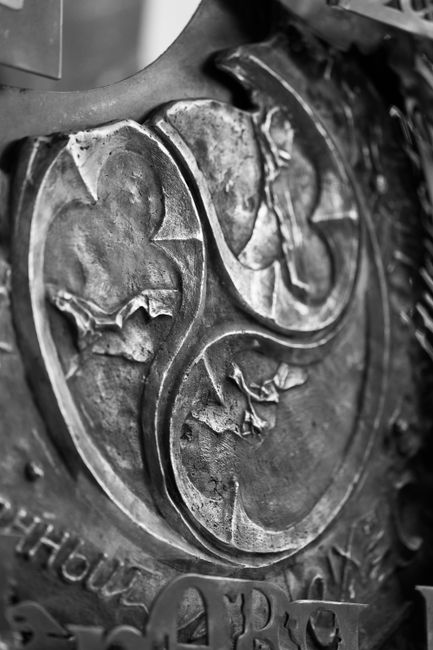
You've seen it a thousand times without once stopping to look. A band of interlace running round the rim of a coffee mug. A pendant in a high-street jeweller's window. A hotel carpet, a wedding band, a tattoo on the forearm of the bloke in front of you at the bar. Celtic design has become wallpaper — the visual equivalent of background music in a lift.
Which is a shame, because the real thing is one of the most sophisticated decorative traditions in Europe, and knowing where it came from genuinely changes the way you see it. A knot isn't just a squiggle. It's a decision somebody made, in a specific place, at a specific moment, with a specific set of beliefs about how the world fits together.
So let's wander through roughly two and a half thousand years of it. From the gold torcs and bronze shields of the Iron Age, through the monks who turned the knot into something close to prayer, to the Victorian entrepreneurs who first sold "Celtic" as a brand — and finally to the designers today who are doing genuinely interesting things with a very old vocabulary.
Before the Knot: The Iron Age Roots
Hallstatt, La Tène and the Curvilinear Turn
The story starts not in Ireland or Scotland but across central Europe. The Hallstatt culture, flourishing from roughly 800 to 450 BC in the Alps and beyond, produced metalwork of astonishing confidence — beaten bronze, gold neck rings, situlae (buckets, believe it or not) covered in geometric ornament and stylised processions of figures.
Then comes La Tène, named after a site on Lake Neuchâtel in Switzerland, running roughly 450 BC until the Roman legions swallowed most of the Celtic world. This is where the aesthetic we'd recognise genuinely crystallises. La Tène craftsmen abandoned the rigid, compass-drawn geometry of their predecessors in favour of something far more fluid: sweeping curves, tendrils that curl back on themselves, leaf-and-palmette motifs stretched into elegant abstractions, and the famous triskele — three spirals revolving around a central point.
What's striking is the technical nerve of it. The Battersea Shield, pulled from the Thames and now in the British Museum, is a masterclass in restrained complexity: red glass enamelling set into bronze, scrollwork that seems to breathe. The Snettisham torcs from Norfolk show gold twisted and cast with a jeweller's precision that modern makers still study. These weren't crude tribal trinkets. They were luxury objects made for people who knew exactly what they were looking at.
What the Iron Age Did Not Have
Here's a useful corrective for anyone who assumes the whole tradition is ancient and unchanging: continuous interlaced knotwork of the sort you see on a modern claddagh ring or a whisky bottle is largely not an Iron Age invention. La Tène art is curvilinear, organic, swirling — but it isn't the endless over-and-under plait that most people mean by "Celtic design."
That particular grammar developed later, in the early medieval period, under the influence of Roman mosaic pavements, Coptic textiles from Egypt, and the interlacing animal ornament of Germanic metalwork arriving in Britain. Celtic art absorbed all of it and produced something new. Which is a rather lovely irony: the most "authentically Celtic" pattern in the world is a product of cultural fusion.
The Grammar of Interlace: How to Read a Knot
Celtic interlace looks chaotic at a glance and is ruthlessly logical up close. Once you learn the rules, you can spot a good piece of design from a bad one in about four seconds — which is genuinely useful when you're standing in a gift shop.
- Continuity. In proper knotwork, the bands are unbroken. A single ribbon winds through the entire panel, passing over and under itself. If a line simply stops dead or fades away, the designer wasn't paying attention.
- Alternation. The over-under sequence must alternate correctly. Where four bands meet, the crossing should read as two over two, not three over one. Get this wrong and the knot looks flat and slightly wrong without anyone being able to say why.
- Symmetry with variation. Panels are usually built on a grid and mirrored, but the best makers deliberately break the symmetry at the edges to keep the eye moving.
- Zoomorphic intrusion. Look closely at medieval work and you'll find the bands aren't always ribbons. Heads, jaws, tails and claws emerge from the interlace. The Book of Kells is absolutely riddled with this — animals swallowing their own bodies, birds turning into spirals.
Beyond knotwork there's a whole family of motifs: the triquetra (three interlocking arcs, later borrowed enthusiastically by everyone from wedding stationers to television fantasy series), the triskele, the spiral, the step pattern, the chequer, and the later Christian additions of the cross and the shamrock. Each has a history. Almost none of them mean what the internet says they mean.
Monks, Manuscripts and the Insular Style
Iona, Kells and the Book That Shouldn't Exist
The golden age of Celtic design is usually dated from roughly the sixth to the ninth centuries, on the islands and coasts of Britain and Ireland. It's called Insular art, and it's the point at which the tradition becomes something you could reasonably call sublime.
Picture the scriptorium at Iona, off the coast of Mull, where Columban monks were producing manuscripts of extraordinary ambition with no electric light and no magnifying glass. The Book of Durrow, the Lindisfarne Gospels, and the Book of Kells — probably begun around 800 and now in Trinity College Dublin — represent the summit. Kells alone contains roughly 2,000 individual decorative motifs, some of them drawn with lines thinner than a hair.
The same sensibility migrated into stone and metal: high crosses covered in panels of interlace and biblical scenes, the Ardagh Chalice, the Tara Brooch, the Derrynaflan Hoard. What unites all of it is an aesthetic conviction that the whole surface should be alive. Leave no blank space; fill it with a pattern that rewards an hour of looking.
The Meaning Question
Popular writing often claims that the endless knot symbolises eternity, that the triquetra represents the Holy Trinity, that the spiral stands for the journey of the soul. Some of this has documentation behind it. Quite a lot doesn't — it's Victorian romanticism, or twentieth-century New Age repackaging, layered on afterwards.
That doesn't make anyone's tattoo meaningless. Symbols accumulate meaning as they travel, and a symbol your grandmother wore means what it means to you. But it's worth being honest about which meanings are medieval and which are 1970s. Good designers tend to be honest about it.
The Victorian Revival and the Invention of the Celtic Brand
Here's where the story becomes properly commercial. In the nineteenth century, a combination of antiquarianism, Romantic nationalism and the boom in tourism turned Celtic ornament into a product category.
Ireland's Celtic Revival gathered pace from the 1840s, drawing on newly published reproductions of the Book of Kells and the high crosses. Jewellers began reproducing brooch designs from museum casts. Scotland's tartan industry — technically unrelated to knotwork, but often sold under the same misty "Celtic" umbrella — was being codified and commercialised at exactly the same time, with a good deal of invented tradition along the way.
The most interesting figure of the age is arguably Archibald Knox, a Manx designer who worked for Liberty & Co. from the 1890s. Knox took Celtic interlace and ran it through a modernist filter, producing pewter and silver ranges — Cymric and Tudric — in which the knotwork became leaner, more architectural, entirely at home in an Arts and Crafts interior. He's the missing link between the monks and the design studio, and his work still looks startlingly contemporary in a way most revivalism does not.
Celtic Design in the Modern Studio
Jewellery and Metalwork
This is where the tradition is strongest, partly because the materials and techniques never really went away. Contemporary makers in Dublin, Glasgow, Galway and Cornwall are producing work that sits comfortably in both camps: wedding bands with hand-cut interlace, pendants using Ogham script, pieces referencing specific archaeological finds rather than generic motifs.
The difference between good and bad here usually comes down to drawing. A cast-in-China triquetra pendant and a hand-chased knot that follows the over-under logic correctly are made from the same idea, but only one of them has been designed.
Textiles, Homeware and Interiors
Interlace translates beautifully into weave, knit and print — it's essentially a grid system already. Irish Aran knitting patterns, Scottish tweed, Welsh tapestry blankets and modern screen-printed cushions all draw on the same curvilinear repertoire. Contemporary textile designers have had particular fun scaling motifs up and down: a knot that reads well at ring size becomes something entirely different on a two-metre wall hanging.
Typography and Branding
Perhaps the most underrated modern application. Uncial scripts derived from Insular manuscripts have a warmth that Roman capitals can't manage, and there's a whole genre of Irish and Scottish branding — distilleries, breweries, pubs, festivals — built on lettering that gestures at the tradition without cosplaying the Middle Ages. The best examples use interlace sparingly, as a structural or ornamental accent, rather than plastering it across everything.
Tattoo Art and the Ethics of Borrowing
Celtic knotwork has become a staple of contemporary tattooing, and this is where things get genuinely interesting. On one hand, it's the tradition continuing to do what it's always done: mark the body with meaning. On the other, a great deal of it is decorative filler chosen from a flash sheet, with the over-under logic butchered and the meaning invented.
None of that is a crime — culture travels, and policing who may use a spiral is a losing game. What's reasonable is asking designers to do their homework. Learn the grammar. Respect the difference between ornament you've studied and ornament you've copied from a tea towel.
Buying Well: A Practical Checklist
If you're shopping for a Celtic design piece and want something that will still look good in twenty years, here's what to look for.
- Check the crossings. Zoom in on the knotwork. Are the over-under sequences alternating correctly? If the maker got that right, they probably got everything else right too.
- Ask what the motif is. "Celtic knot" is not an answer. A triquetra, a triskele, a spiral, a zoomorphic panel and a plaitwork band are different things with different histories.
- Be sceptical of Ogham. It's a genuine fourth- to sixth-century Irish script, and it's very frequently rendered as nonsense. If the piece claims to say something, ask what.
- Look at the making. Is the pattern cast, etched, laser-cut, hand-chased, embroidered or printed? Each is legitimate — but the price should reflect which one it is.
- Check the provenance claim. "Designed in Ireland" and "made in Ireland" are different statements. Neither is better, but you should know which you're paying for.
- Buy the drawing, not the story. A well-drawn knot in silver beats a badly-drawn knot in gold, every single time.
A Living Tradition, Not a Pattern Book
The thing worth remembering about Celtic design is that it has never been static. La Tène craftsmen borrowed from the Mediterranean. The monks of Iona borrowed from Saxon metalwork and Coptic textiles. Archibald Knox borrowed from the Arts and Crafts movement. Every generation has taken the same handful of ideas — the endless line, the spiral, the balance of dense ornament against a quiet field — and done something new with them.
That's the real inheritance. Not a fixed set of patterns to be reproduced faithfully forever, but a design language confident enough to absorb outside influence and come out sounding like itself.
So next time you see a knot on a mug, look a bit closer. If the line runs unbroken, if the crossings alternate, if someone clearly cared — buy it, wear it, hang it on your wall. That's not nostalgia. That's a two-thousand-year-old conversation, and you've just joined it.